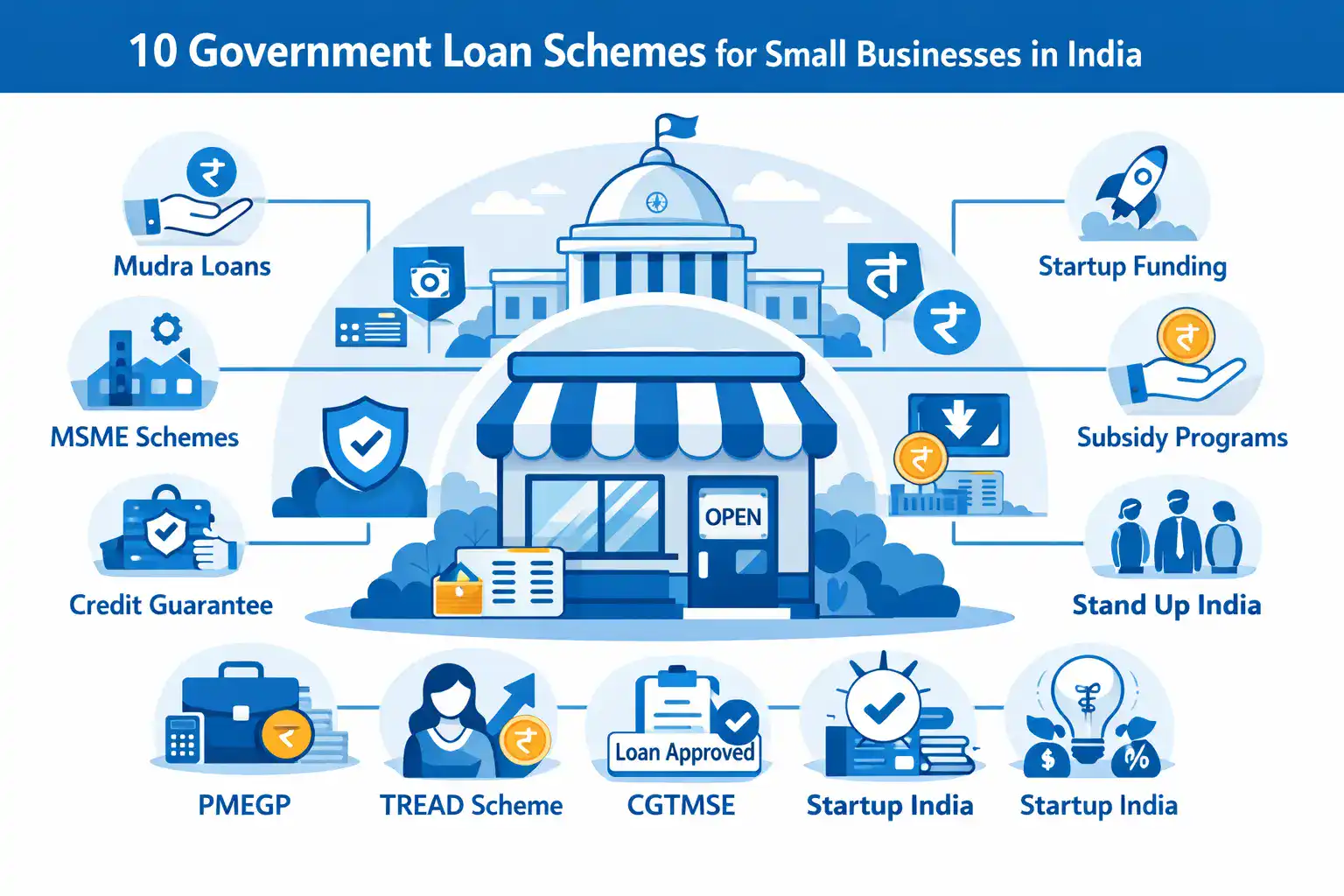
Starting or expanding a small business often requires financial support. However, many entrepreneurs face difficulties securing loans due to strict eligibility criteria, lack of collateral, or limited credit history. To encourage entrepreneurship and support the growth of micro, small, and medium enterprises (MSMEs), the Government of India has introduced several loan schemes specifically designed for small businesses.
These government-backed programs provide affordable financing, subsidies, and credit guarantees to help businesses grow. From startup funding to collateral-free loans, these schemes are aimed at improving access to capital for entrepreneurs across India.
In this guide, we will explore the 10 best government loan schemes for small businesses in India, including their benefits, eligibility, and how entrepreneurs can apply.
Why Government Loan Schemes Are Important for Small Businesses
Small businesses are the backbone of the Indian economy. According to the Ministry of Micro, Small and Medium Enterprises, MSMEs contribute significantly to employment generation, exports, and economic development.
However, many small businesses face financial challenges such as:
- Limited access to credit
- High interest rates from private lenders
- Lack of collateral security
- Difficulty obtaining bank approvals
Government loan schemes help address these issues by providing:
- Collateral-free financing
- Lower interest rates
- Government-backed credit guarantees
- Subsidies for startups and new businesses
These benefits make government loan programs one of the best funding options for entrepreneurs.
1. Pradhan Mantri Mudra Yojana (PMMY)
The Pradhan Mantri Mudra Yojana is one of the most widely used government loan schemes for micro and small businesses in India. It provides financial support to entrepreneurs who want to start or expand their businesses.
Key Features
- Loans up to ₹10 lakh
- Collateral-free financing
- Available through banks, NBFCs, and microfinance institutions
Loan Categories
| Category | Loan Amount |
|---|---|
| Shishu | Up to ₹50,000 |
| Kishor | ₹50,000 – ₹5 lakh |
| Tarun | ₹5 lakh – ₹10 lakh |
This scheme is commonly used by shop owners, small traders, service providers, and home-based entrepreneurs.
2. Stand Up India Scheme
The Stand Up India Scheme was introduced to encourage entrepreneurship among women and members of Scheduled Castes (SC) and Scheduled Tribes (ST).
Key Highlights
- Loan amount from ₹10 lakh to ₹1 crore
- Support for new (greenfield) enterprises
- Available for manufacturing, service, and trading businesses
The scheme aims to promote inclusive business growth and create employment opportunities.
3. Credit Guarantee Fund Trust for Micro and Small Enterprises (CGTMSE)
The CGTMSE scheme helps small businesses obtain loans without collateral.
Benefits
- Government-backed credit guarantee
- Encourages banks to lend to MSMEs
- Reduces risk for financial institutions
Through this scheme, entrepreneurs can access business loans even if they do not have property or assets to pledge as collateral.
4. Prime Minister’s Employment Generation Programme (PMEGP)
The Prime Minister’s Employment Generation Programme supports entrepreneurs who want to establish new businesses.
Main Features
- Government subsidy on project cost
- Financial assistance for new enterprises
- Available in both rural and urban areas
The scheme is implemented by the Khadi and Village Industries Commission, which promotes small-scale industries and rural employment.
5. National Small Industries Corporation Subsidy Scheme
The National Small Industries Corporation provides financial and marketing support to MSMEs.
Key Benefits
- Assistance for raw material procurement
- Marketing and business support
- Credit facilitation for small industries
This scheme helps businesses improve operational efficiency and expand market reach.
6. Credit Linked Capital Subsidy Scheme (CLCSS)
The Credit Linked Capital Subsidy Scheme supports small businesses that want to upgrade their technology and machinery.
Advantages
- Capital subsidy for technology upgrades
- Increased productivity and efficiency
- Encourages modernization of MSMEs
Manufacturing businesses often benefit the most from this scheme.
7. Startup India Seed Fund Scheme
The Startup India Seed Fund Scheme was introduced to support early-stage startups.
Key Features
- Financial assistance for product development
- Support for market entry and commercialization
- Encourages innovation and entrepreneurship
This initiative is part of the broader Startup India Initiative, which aims to build a strong startup ecosystem in India.
8. SIDBI Make in India Soft Loan Fund
The SIDBI Make in India Soft Loan Fund supports manufacturing startups and MSMEs.
Key Benefits
- Soft loans with flexible repayment
- Encouragement for manufacturing businesses
- Promotion of the Make in India campaign
The scheme is implemented by the Small Industries Development Bank of India, which focuses on the development of small industries.
9. Trade Related Entrepreneurship Assistance and Development Scheme (TREAD)
The TREAD scheme is specifically designed to support women entrepreneurs.
Benefits
- Financial assistance for women-owned businesses
- Training and skill development programs
- Access to bank credit through NGOs
This scheme helps women gain financial independence and build successful enterprises.
10. Atmanirbhar Bharat MSME Loan Scheme
The Atmanirbhar Bharat MSME Loan Scheme was introduced to support small businesses during economic disruptions.
Key Features
- Emergency credit line support
- Additional working capital for MSMEs
- Government-backed loan guarantees
This scheme helps businesses recover from financial challenges and maintain operations.
Comparison of Government Loan Schemes
| Scheme | Loan Amount | Target Beneficiaries |
|---|---|---|
| Mudra Yojana | Up to ₹10 lakh | Micro businesses |
| Stand Up India | ₹10 lakh – ₹1 crore | Women & SC/ST entrepreneurs |
| CGTMSE | Depends on lender | MSMEs without collateral |
| PMEGP | Project-based funding | New entrepreneurs |
| Startup India | Startup funding | Early-stage startups |
How to Apply for Government Business Loans
Applying for government loan schemes usually involves a simple process.
Steps to Apply
- Identify the suitable government loan scheme
- Prepare required documents
- Submit application through a bank or official portal
- Complete verification and approval process
Documents Required
- Aadhaar card
- PAN card
- Business registration documents
- Bank statements
- Business plan or project report
Having a strong business plan can significantly improve loan approval chances.
Tips for Getting Government Loan Approval
Entrepreneurs can increase their chances of loan approval by following these tips.
Maintain Good Credit Score
Banks consider credit history when approving loans.
Prepare Detailed Business Plan
A clear business plan helps lenders understand the business model.
Maintain Proper Financial Records
Financial documents help banks evaluate repayment ability.
Choose the Right Loan Scheme
Selecting the right scheme based on business needs increases approval chances.
Conclusion
Government loan schemes provide excellent opportunities for entrepreneurs to start and grow their businesses. These programs offer financial support, subsidies, and credit guarantees that make it easier for small businesses to access funding.
By understanding the available schemes and selecting the right option, entrepreneurs can take advantage of government initiatives designed to promote economic growth and entrepreneurship in India.
With proper planning, documentation, and financial discipline, government-backed loans can become a powerful tool for building a successful business.
Disclaimer:
The information provided in this article is for educational purposes only. Loan schemes and eligibility criteria may change according to government policies. Please refer to the official government websites for the latest details.